Morning Raves and Sober-Curious Leisure in 2026
Morning raves are changing the usual timetable of social life. Instead of arriving at a club close to midnight and leaving after sunrise, people are turning up early for DJs, dancing, coffee and conversation, then carrying on with the rest of their day. Many of these events are alcohol-free, while others attract people who describe themselves as sober-curious: they may not have stopped drinking completely, but they are questioning how often they drink and why alcohol has traditionally been treated as a default part of socialising. By 2026, this behaviour is no longer confined to Dry January or specialist sobriety groups. Alcohol-free events, daytime dance sessions and no- and low-alcohol drinks have become much more visible. Morning raves sit where several changes meet: different attitudes to drinking, growing interest in daytime entertainment and a desire to meet people without sacrificing the following morning to a late night out.
Why Morning Raves Are Becoming a Real Alternative to Nightlife
The basic idea is simple: take the music, sound system and communal energy associated with a night out and move them to a time when most clubs would normally be closed. Start times vary considerably. Some sessions begin at six or seven in the morning, while others are closer to a late-morning party and finish around lunchtime. A clear British example came from University College London in February 2026, when its Student Support and Wellbeing Services organised an alcohol-free morning rave from 7:00 to 8:30 am with a professional DJ, electronic music and hot drinks. It was presented as a social event rather than an exercise class, which illustrates an important part of the trend: participants are still going somewhere specifically to dance and spend time with other people.
The format is also established beyond Britain. Daybreaker, one of the better-known organisers associated with daytime and sober dancing, continued scheduling events during 2026, including morning sessions beginning as early as 6:00 am. Its calendar shows how broad the concept has become, with events in different cities and formats ranging from shorter dance gatherings to longer sober festivals. In September 2026, for example, its ALIVE event in New York was scheduled as a sunrise-to-sunset sober festival. These examples do not mean that every morning rave follows the same model. They show instead that early dancing has developed from an unusual novelty into a recognisable type of social event with enough interest to support regular programming.
Timing is one of its strongest attractions. Traditional nightlife asks people to reorganise sleep, travel home late and accept that the next morning may be unproductive. A daytime event changes that calculation. Someone can dance for two or three hours and still meet friends for lunch, run errands or spend the afternoon elsewhere. It may also suit people who enjoy electronic music but have become less interested in staying out until three or four in the morning. This does not make morning parties automatically healthier: getting up at five after inadequate sleep defeats much of the point. Their appeal comes from giving people another choice. Dancing no longer has to be tied to a particular hour, and enjoying club music does not automatically require an entire night built around drinking.
What Actually Happens at a Morning Rave?
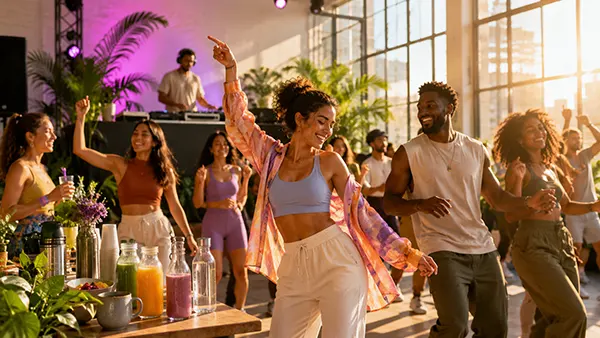
The dance floor remains the centre of most morning raves. There is normally a DJ or a sequence of DJs, amplified music and enough space for people to move much as they would at an evening event. The surroundings, however, can be very different. Morning sessions have appeared in conventional music venues, university buildings, cafés, studios, outdoor spaces and temporary event locations. Coffee, tea, juice and alcohol-free drinks frequently replace the usual bar order. People may arrive in gym clothes, ordinary streetwear or full rave outfits depending on the event. There is no single dress code or expected personality. One of the reasons the format works is that it keeps something familiar — dancing together to loud music — while removing several habits that people may associate with a conventional night out.
Some organisers add activities such as yoga, guided movement, breathwork, sauna sessions or cold-water experiences. Daybreaker, for instance, has incorporated yoga and other wellbeing activities into some of its programmes. These additions have helped produce labels such as “wellness rave”, but they are not essential to a morning rave and should not distract from what most people are actually there to do. An event does not need to turn dancing into a self-improvement project. For many participants, the attraction is much more ordinary: good music, a lively room and the chance to be around other people. Coffee before a DJ set can be enjoyable without being presented as a life-changing ritual, and a morning spent dancing does not require a complicated philosophy behind it.
It is also worth checking the event description rather than assuming that “morning rave” always means “sober rave”. The terms overlap, but they are not identical. Some events explicitly prohibit alcohol and recreational drugs, while others are simply held during the day and may operate under ordinary venue rules. Anyone who specifically wants an alcohol-free environment should check what is served and how the organiser describes the event before buying a ticket. The same applies to other practical details such as minimum age, re-entry, cloakrooms and accessibility. This small amount of preparation matters because the sober-curious scene includes several different audiences: lifelong non-drinkers, people in recovery, people temporarily avoiding alcohol and people who still drink but want more social occasions where drinking is not expected.
Sober-Curious Leisure Is About Choice Rather Than a New Rulebook
The expression “sober curious” is widely associated with British author Ruby Warrington, who began using the term in the mid-2010s and brought it to a wider audience through her 2018 book Sober Curious. The idea is deliberately different from declaring permanent abstinence. It asks people to pay attention to when they drink, what they expect alcohol to do for them and how they feel when they leave it out. A person might stop drinking completely, take several alcohol-free months, drink only on selected occasions or simply become more deliberate about each decision. That flexibility explains why the idea has travelled beyond sobriety communities. It gives people language for changing a habit without requiring them to adopt a new identity before they have decided what they actually want.
Current UK data shows that moderation is increasingly common rather than marginal. The Drinkaware Monitor 2026 found that 91% of drinkers reported using at least one of the moderation techniques included in the survey, up from 87% in 2025. It also found that 39% had tried to cut down their alcohol consumption. Drinkaware reported in August 2026 that 48% of drinkers were consuming no- or low-alcohol products as a way of moderating, compared with 44% the previous year. These figures need to be read carefully: they do not mean that Britain is becoming universally sober, and the same 2026 research found that some risky drinking measures had increased. What they do show is that actively managing alcohol intake has become a routine part of drinking behaviour for a substantial section of the population.
Younger adults have been particularly important to the change. Drinkaware research published in 2025 found that 49% of drinkers aged 18 to 34 were choosing no- or low-alcohol drinks to help moderate their drinking, compared with 28% in 2018. That shift helps explain why alcohol-free leisure can support events that would previously have been strongly associated with drinking. A DJ set no longer has to be organised around a bar to feel socially credible. The same change can be seen in alcohol-free cocktail events, tasting sessions and other social occasions built around conversation and participation rather than rounds of alcoholic drinks. Morning raves are one visible part of this wider adjustment in what people expect from their free time.
Why Alcohol-Free Socialising Feels More Normal in 2026
Choice has improved significantly. A person avoiding alcohol is no longer limited to water, cola or a single sweet mocktail in many venues. Alcohol-free beers, sparkling drinks, spirits-style products and ready-to-drink alternatives have become more common, making it easier for groups with different drinking preferences to share the same occasion. There is one detail worth remembering: “alcohol-free” does not always mean absolute zero alcohol. UK labelling practices allow some products described this way to contain very small amounts, and Drinkaware advises people who need to avoid alcohol completely to check the label rather than relying only on the category name. At sober events, organisers can make this easier by clearly identifying genuinely 0.0% options.
The setting itself can matter as much as the drinks. Saying no to alcohol in a pub at midnight can feel more noticeable because drinking is built into the occasion. At an alcohol-free morning rave, nobody needs to explain why they have ordered coffee instead of beer; coffee is already normal there. That change in expectation removes a small but persistent piece of social pressure. It can also make mixed groups easier to organise. Friends who drink, friends who are taking a break and friends who never drink can attend the same event without one group having to adapt to the habits of another. The most successful sober-curious leisure therefore does not constantly remind people that alcohol is missing. It gives them enough to do that its absence stops being the main subject.
This is also why sober curiosity should not be treated as a competition in personal discipline. Someone who chooses a glass of wine after several alcohol-free weeks has not necessarily failed at what they were trying to do. For many people, the purpose is to make alcohol a conscious choice rather than an automatic part of dinner, celebrations or nights out. At the same time, permanent sobriety deserves to be respected as something different from a lifestyle experiment. People may avoid alcohol for health, religious, personal or recovery reasons and may have no interest in being described as sober-curious. A genuinely inclusive social culture leaves room for all of these positions without asking anyone to justify what is in their glass.
How to Try Morning Raves Without Turning Them Into a Wellness Project
A first morning rave does not require a dramatic change in routine or a promise to stop drinking. It can simply be treated as another type of event. Look at the start and finish time, music style, alcohol policy and venue before booking. An event beginning at 6:00 am is very different from one beginning at 10:30, particularly if travel is involved. It is also useful to know what the ticket actually covers. Some sessions are straightforward DJ events, while others combine dancing with fitness or wellbeing activities that may take up a significant part of the schedule. Choosing according to what you genuinely enjoy is more sensible than attending something because its morning start has been presented as inherently virtuous.
Basic preparation makes the morning considerably better. Going to bed at a reasonable time matters more than trying to compensate for short sleep with several coffees. Eat something if the event runs across the time when you would normally have breakfast, take water if the venue allows it and wear clothes and shoes in which you can comfortably move. Loud music is still loud music at eight in the morning, so hearing protection can be useful in the same way it is at an evening concert or club. If caffeine is being served, there is no need to treat unlimited coffee as the alcohol-free equivalent of rounds of shots. The point is to enjoy the event, not to replace one form of excess with another.
The social side may feel unfamiliar at first because morning events remove some of the scripts associated with nightlife. People are generally more alert, conversation is easier and there is less reason to stay simply because it is too late to go anywhere else. That can make an early party surprisingly casual. Arranging to meet one friend there can help if arriving alone feels awkward, although solo attendance is common at community-focused events. It is also perfectly reasonable to leave after an hour if the format is not appealing. Sober-curious leisure works best when curiosity remains genuine. It loses much of its value when people start treating sunrise dancing, cold showers or alcohol-free months as another set of lifestyle obligations they have to perform correctly.
Where the Trend Has Limits and Who Needs Extra Caution
Morning raves are easy to romanticise because they combine several ideas that currently carry positive associations: community, movement, moderation and a better relationship with free time. None of those benefits is guaranteed. A crowded room at 7:00 am can be just as unpleasant as a crowded room at midnight if the music is not to your taste, the venue is badly organised or you have slept for four hours. Alcohol-free events do not automatically solve loneliness, social anxiety or unhealthy routines either. There is also a commercial side to the trend. Once ordinary activities such as dancing, coffee and meeting friends are repackaged as wellness, simple events can become expensive or overloaded with claims about personal transformation. Participants can reasonably enjoy the format without accepting every claim attached to it.
Accessibility also deserves more attention as morning raves become more common. Early public transport may be limited, and a dawn start can be impractical for shift workers, carers, parents and people travelling from outside city centres. Loud sound, flashing lights, dense crowds and long periods of standing can create additional barriers. Good organisers should make information about step-free access, seating, lighting, sound intensity, quiet areas and event timings easy to find before ticket purchase. Daytime scheduling can make nightlife-style entertainment available to some people who previously avoided late events, but it can exclude others. There is no single timetable that makes an event automatically inclusive.
Finally, sober-curious leisure should not be confused with treatment for alcohol dependence. The NHS states that suddenly stopping drinking can be dangerous for someone who is physically dependent on alcohol and experiencing withdrawal symptoms, and medical advice should be sought before attempting to stop in that situation. For people who drink without dependence and simply want to reduce their intake, current UK guidance advises keeping regular consumption below 14 units a week, spreading drinking over several days if drinking at that level and including drink-free days. Morning raves can make those drink-free social occasions easier and more enjoyable, but their broader significance is cultural rather than medical. They show that music, dancing and meeting people do not have to wait until midnight — and that alcohol no longer has to be the price of admission to a lively social life.